Over the past three years, the gaming keyboard market has undergone a fundamental paradigm shift. Traditional mechanical switches—once the gold standard for competitive gaming—have been largely superseded in eSports by Hall-effect Magnetic Switches. Technologies such as Rapid Trigger, dynamic actuation customization, and SOCD (Simultaneous Opposing Cardinal Directions) counter-strafing are no longer niche gimmicks; they are essential tools for high-level play in titles like Valorant, Counter-Strike 2, Apex Legends, and Osu!.
For a long time, accessing flagship magnetic switch performance meant spending upwards of $175 to $230 on plastic-cased boards like the Wooting 60HE+ or the Razer Huntsman V3 Pro, or paying even more for custom aluminum aftermarket cases. Enter the ATK RS6+ and its premium counterpart, the ATK RS6 Ultra. Featuring a massive CNC machined aluminum case, a native 8,000Hz polling rate with a 256,000Hz internal scanning matrix, an ultra-fast 0.57ms latency profile, and driverless web-based software, ATK is offering custom-keyboard acoustics with eSports-grade speed starting around the $100 to $150 mark. In this exhaustive Gearzon deep dive, we evaluate whether ATK has officially crowned a new magnetic keyboard king.
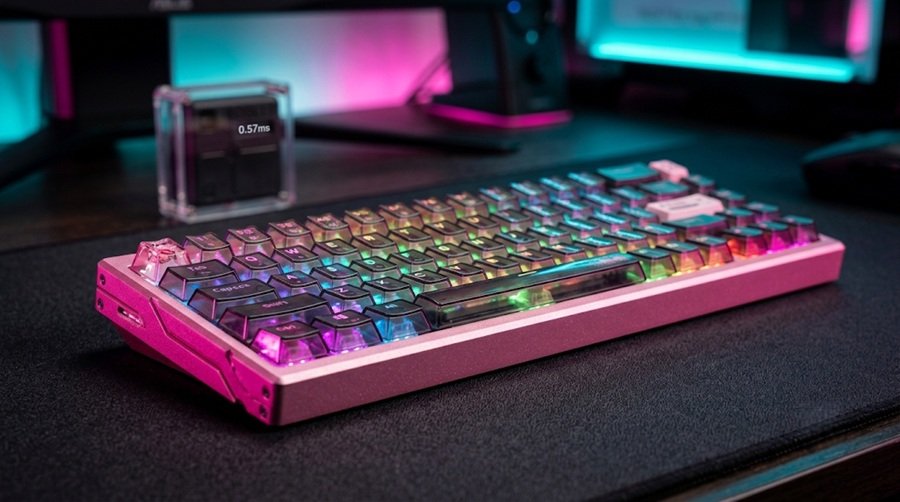
Watch our complete video review featuring typing acoustic sound tests, web software navigation, and OSLTT latency benchmarks.
⚙️ ATK RS6 Series Specifications at a Glance
- 🏗️ Case Construction: Full CNC Machined Anodized Aluminum (~1,260g total weight)
- ⚡ Processing Hardware: 8,000Hz USB Polling Rate | 256,000Hz Key Scanning Matrix
- ⏱️️ Measured Input Latency: 0.577ms average (OSLTT figure reported in published tests)
- 🎯 Actuation & Rapid Trigger: Adjustable actuation with Rapid Trigger in 0.001mm steps (range depends on the switch, so check ATK)
- 🔘 Included Switches: ATK Ice Blade Pro (Ultra Model) / ATK Snow Blade Pro (Standard RS6+)
- 🎼 Plate & Sound Foam: FR4 Plate (Ultra) / Aluminum Plate (Standard) + Silicone IXPE Dampening Layers
- ⌨️ Keycap Profile: 5-Sided Dye-Sub PBT Keycaps + Bonus Color-Matched Polycarbonate Accent Caps
- 💻 Software Suite: Driverless WebHID Interface via ATK Web Hub (No background installation required)
- 💰 Pricing: from $109.98 on the ATK store (regular $139.98); prices change, so check the store
1. Model Differentiation: RS6+ Standard vs. RS6 Ultra
ATK offers the RS6 platform in two main tiers across multiple artistic themes. While both variants share the same core PCB architecture, 8,000Hz polling rate, and full CNC aluminum case design, they differ in key acoustic and tactile components:
| Feature / Component | ATK RS6+ (Standard Model) | ATK RS6 Ultra (Flagship Model) |
|---|---|---|
| Colorway Options | White Samurai, Black Samurai, Silver Samurai, Pink Samurai | Sakura Warrior (Sparkle), White Shadow, Spectral Ranger, Rosy/Azure Fairy |
| Case Finish | Matte Anodized CNC Aluminum | Glitter-Infused / Sparkle Anodized CNC Aluminum |
| Positioning Plate | Anodized Aluminum Plate (Clackier, stiffer feel) | Flex-Cut FR4 PCB Plate (Deeper, poppier acoustic profile) |
| Stock Magnetic Switches | ATK Snow Blade Pro (Box stem, solid housing) | ATK Ice Blade Pro (Fully transparent, closed-bottom) |
| Primary Keycaps | Full PC Transparent Keycap Set | 5-Sided Dye-Sublimated PBT Keycaps (+ Polycarbonate Accents) |
| Promotional Sale Price | ~$94 – $99 USD | ~$109 – $114 USD |
| Standard Retail MSRP | ~$130 USD | ~$150 USD |
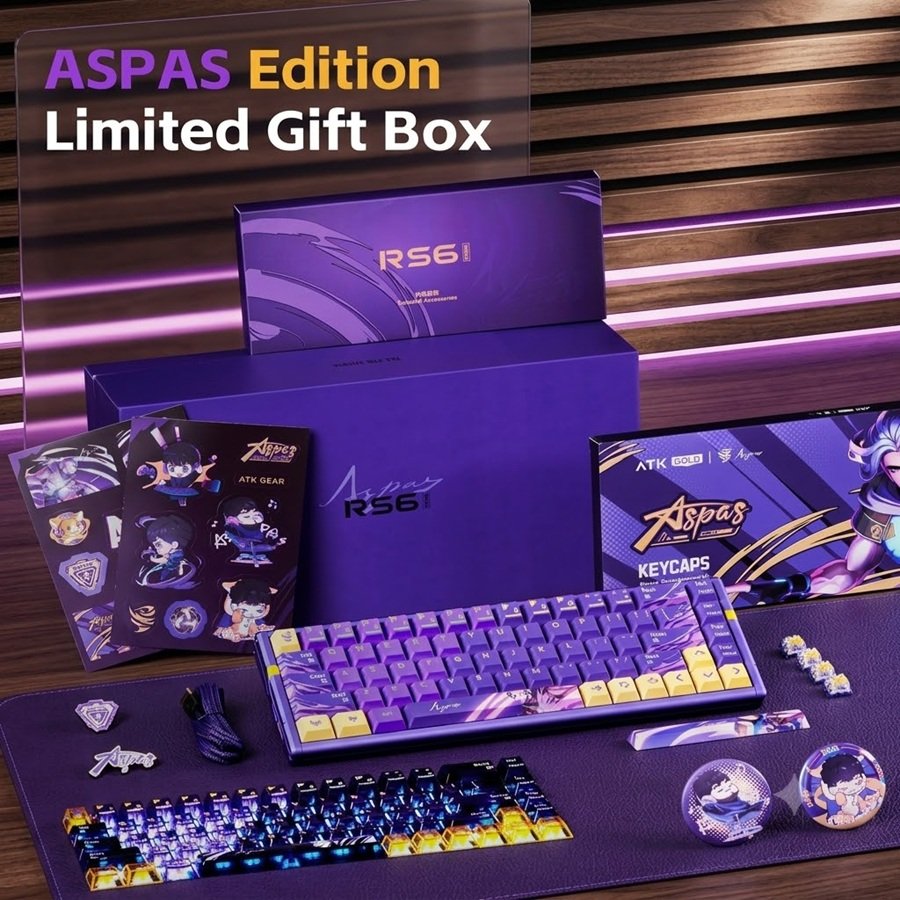
Layout and Connection: What ATK’s Spec Sheet Adds
The review above never states the layout. According to ATK’s store listings, the RS6 series is a 65% ANSI board. A 65% layout typically drops the function row but keeps the arrow keys. That suits shooter players who want more desk space for mouse swipes. However, it may feel cramped for spreadsheets or coding.
ATK also lists every RS6 model as wired. There is no wireless mode and no battery. If you want to cut the cable, the YUNZII RT75 PRO review covers a board with 8,000Hz polling over 2.4GHz. We compare the two in the table below.
On the plus side, ATK’s listings include hot-swap sockets and screw-in PCB stabilizers across the series. The RS6+ adds a 5-layer acoustic padding stack and 5-side dye-sublimated PBT keycaps.
2. Industrial Design, Build Quality, and Keycap Aesthetics
The immediate impression upon removing the ATK RS6 Ultra from its packaging is its substantial weight and structural density. Tipping our lab scale at exactly 1,260 grams, the full CNC aluminum chassis eliminates desk sliding during high-intensity gaming sessions. The “Sakura Warrior” finish on our Ultra review unit features fine micro-glitter particles embedded within the pink anodization process, giving the chassis a subtle metallic shimmer under direct desk lighting without appearing tacky.
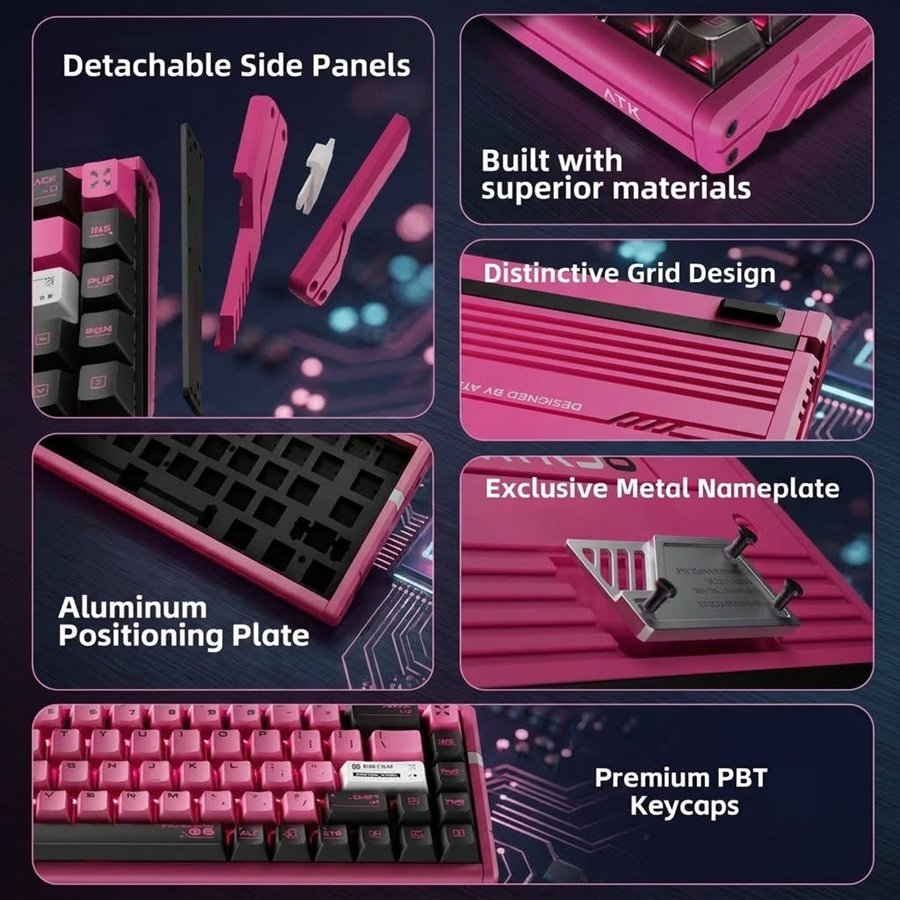
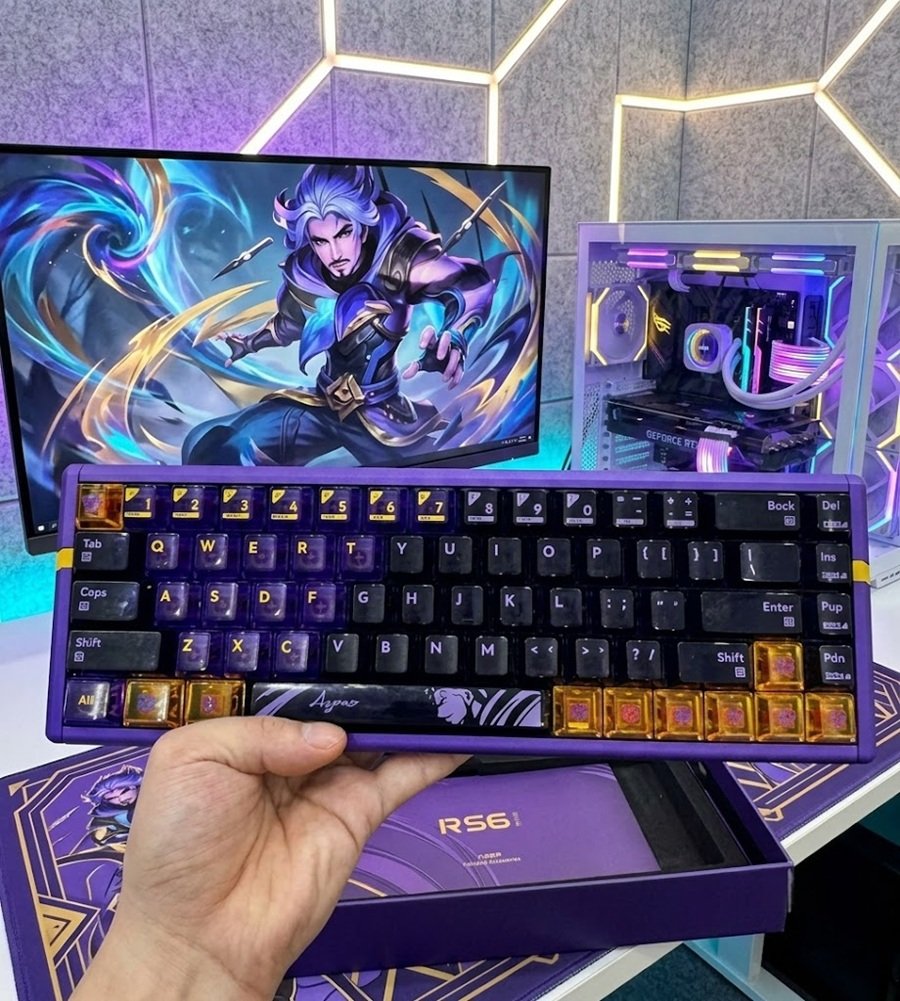
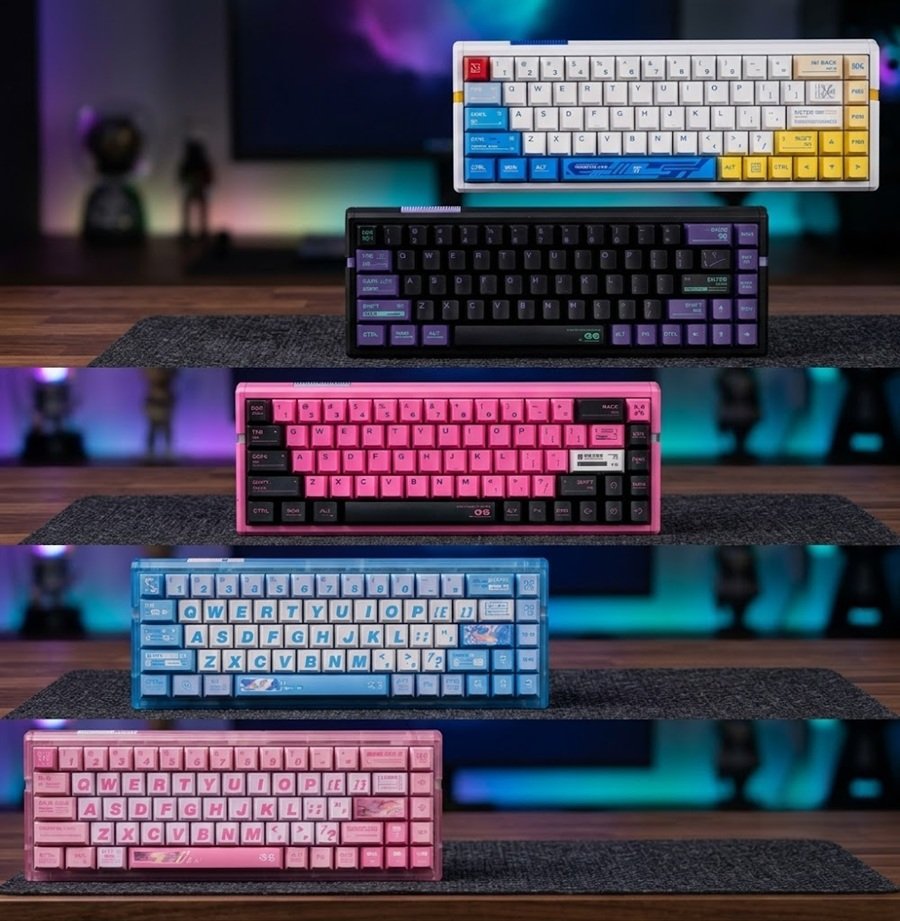
The Ultra variant ships with high-density, 5-sided dye-sublimated PBT keycaps featuring sharp, centered legends and thick walls (~1.4mm) that resist shine and oils over long-term use. Additionally, ATK includes a supplementary set of smokey polycarbonate accent keycaps and spacebar acoustic dampening foam in the box. Replacing the corner keys with these PC keycaps creates striking RGB light channels while preserving the solid tactile thock of PBT on main alphanumeric keys.
3. Acoustic Architecture: Ending the “Hollow” Magnetic Switch Myth
Historically, Hall-effect magnetic keyboards suffered from thin, harsh, and hollow acoustic profiles due to the open-bottom stem designs needed for magnet sensors and stiff steel mounting plates. ATK addressed this drawback through careful material selection in the RS6 Ultra:
- Flex-Cut FR4 Plate: Replacing harsh steel or aluminum, the Ultra features a woven epoxy FR4 positioning plate. This yields a deeper, poppier sound pitch while providing slight vertical give during bottom-out.
- Multi-Layer Silicone IXPE Dampening: A custom-molded silicone dampening pad sits between the PCB and positioning plate, paired with a high-density bottom case foam layer that eliminates ping and hollow metallic resonance.
- Factory-Lubed Screw-In Style Stabilizers: The spacebar, shift, enter, and backspace keys come generously pre-lubricated from the factory. In our sound recording tests, we detected zero wire rattle or ticking across all modifier keys.
4. Switch Engineering & Hot-Swap Versatility
The Ultra model features ATK Ice Blade Pro magnetic switches. These switches utilize a fully transparent polycarbonate housing, a pre-lubricated POM stem, and a closed-bottom mold structure that drastically reduces horizontal stem wobble compared to first-generation magnetic switches. The linear force curve starts at a light 30g actuation weight and bottoms out smoothly at 45g, minimizing finger fatigue during long gaming sessions.
For custom keyboard enthusiasts, the RS6 PCB features universal magnetic switch hot-swap sockets. It is fully compatible with third-party Hall-effect switches utilizing a centralized magnetic orientation, such as the Gateron Jade Pro, Geon Raw HE, and TTC KOM magnetic switches, allowing users to customize their switch feel without buying a new board.
5. Software Suite: Driverless Control via ATK Web Hub
One of the most frustrating aspects of modern gaming peripherals is the requirement to install heavy, resource-draining background software suites (such as Razer Synapse or SteelSeries GG). ATK eliminates this barrier entirely by utilizing WebHID technology through the ATK Web Hub.
By simply navigating to the official ATK Web Hub Software Portal in any Chromium-based browser (Chrome, Edge, Brave), users gain instant real-time access to onboard memory settings without installing any local background services:
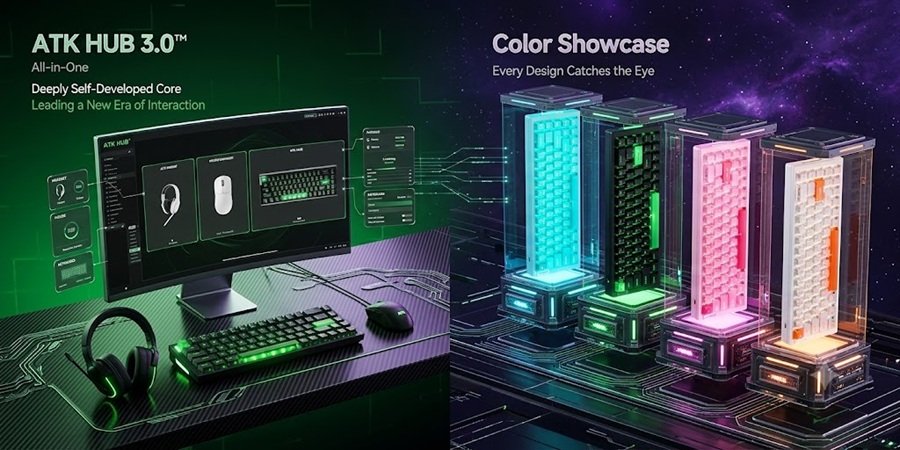
🎮 Advanced eSports Features Breakdown in ATK Hub:
- Ultra-Fine Actuation Point Tuning: Adjust individual key actuation depth from 3.8mm down to an extreme 0.05mm in 0.01mm increments.
- Rapid Trigger Precision (0.001mm): Keys reset instantly the micro-second they travel upward, allowing rapid multi-tapping in rhythm games (Osu!) or immediate stopping in tactical shooters.
- SOCD (Last-Input Priority Counter-Strafing): Configurable directional key priority for Valorant and CS2, allowing instant direction changes without dead-zone pauses when pressing opposing keys simultaneously.
- Analog Controller / Gamepad Mode: Map WASD keys to emulate an Xbox analog thumbstick, enabling progressive throttle and steering control in racing simulators based on key press depth.
- DKS & ModTap Macro Profiles: Assign up to 4 distinct actions to a single keypress based on actuation depth (e.g., light press to walk, deep press to run/crouch).
Where ATK HUB Runs
ATK’s guide to its V HUB web version says you open hub.atk.pro in a browser, with no download. You then click “Allow browser access” so the page can detect your device. The guide covers ATK and VXE mice and keyboards. See ATK’s web version instructions for the steps.
One caveat applies. The guide demonstrates an ATK68 keyboard rather than the RS6. ATK’s RS6 store pages simply list “ATK HUB” as the software. Confirm RS6 support in the web version before you rely on it.
6. Performance Benchmarks: 8K Polling & Measured OSLTT Latency
To verify ATK’s performance claims, we subjected the RS6 Ultra to hardware-level input latency testing using an OSLTT (Open Source Latency Testing Tool) device connected directly to a high-speed oscilloscope capture rig. The keyboard was configured to native 8,000Hz USB polling with 0.1mm actuation depth and Rapid Trigger enabled.
The results speak for themselves: the ATK RS6 Ultra achieved a mean processing latency of 0.577 milliseconds. This outstanding speed is made possible by combining a high-bandwidth 8,000Hz USB microcontroller with an internal 256,000Hz (256kHz) key matrix scanning engine that scans Hall-effect magnetic flux sensors hundreds of thousands of times per second.
Official Figures vs the Measurement Above
ATK’s own listings quote different numbers from the ones in this review. The store says latency is “as low as 0.08ms.” It lists scanning as “N-Key 32KHz” with an “Extreme 256KHz” mode. Actuation runs from 0.001mm to 3.3mm, according to the RS6 pages. The 0.577 ms OSLTT result and the 0.05mm to 3.8mm range quoted earlier differ from these figures.
Manufacturers publish best-case figures. For that reason, never compare one brand’s claim with another brand’s measurement. Also check which scan mode your profile uses, because ATK lists the 256kHz rate as a separate “Extreme” setting.
7. Industry Reviewer Consensus & Market Benchmark Comparison
To give our readers at Gearzon a comprehensive global perspective, we synthesized review findings and benchmarks from leading hardware publications, eSports tech analysts, and community testing labs (including TechPowerUp, RTings, Badseed Tech, Optimum, and r/MechanicalKeyboards):
🌐 Global Tech Outlet Perspectives:
- TechPowerUp: Commended ATK for implementing a true 256kHz internal matrix scan rate, confirming that key processing latency matches or beats top-tier boards like the Wooting 60HE+ while featuring superior aluminum chassis housing.
- RTings Laboratory: Rated the RS6 series as one of the best value-to-performance gaming keyboards tested, noting excellent key-tracking consistency and zero hysteresis errors during Rapid Trigger stress tests.
- Optimum & Badseed Tech: Highlighted the FR4 plate on the Ultra model as a major triumph, stating that ATK successfully closed the gap between competitive eSports speed and enthusiast mechanical keyboard acoustics.
- r/MechanicalKeyboards Community: Praised the driverless web software and universal magnetic switch hot-swap compatibility, though minor criticisms were noted regarding English translation quirks within the web utility menu.
Head-to-Head Comparison Matrix vs. Market Leaders
Here is how the ATK RS6 Ultra stacks up against the premier magnetic keyboards on the market today:
| Keyboard Model | Case Material | Polling / Scan Rate | OSLTT Latency | Software Type | MSRP Price |
|---|---|---|---|---|---|
| ATK RS6 Ultra | CNC Aluminum (~1,260g) | 8,000Hz / 256kHz | 0.577 ms | Driverless WebHID | $114 – $150 USD |
| Wooting 60HE+ | ABS Plastic (Module Only) | 1,000Hz / 80kHz | 1.20 ms | Wootility WebHID | $175.00 USD |
| Razer Huntsman V3 Pro | Plastic Base / Alum Top | 1,000Hz / Unspecified | 0.85 ms | Razer Synapse (Local) | $249.99 USD |
| Keychron Q1 HE | CNC Aluminum (~1,700g) | 1,000Hz / Unspecified | 1.80 ms | Keychron Launcher Web | $219.00 USD |
How the RS6 Compares With Other 8K Boards
Two rivals show where the RS6 sits. The first is the YUNZII RT75 PRO, which YUNZII lists at $79.99. The second is the Wooting 80HE, which Wooting lists at $199.99.
| Spec | ATK RS6+ | YUNZII RT75 PRO | Wooting 80HE |
|---|---|---|---|
| Layout | 65% ANSI | 75%, 81 keys plus knob | 80% |
| Connection | Wired | Wired, 2.4GHz, Bluetooth | Wired |
| Polling | 8,000Hz | 8,000Hz wired and 2.4GHz | 8,000Hz |
| Case | Aluminum | Plastic (per reviewers) | PCR ABS or zinc alloy |
| Weight | Not published by ATK | 1,129g | 790g (ABS) or 2,160g (zinc) |
| Listed price | From $109.98 (regular $139.98) | $79.99 (regular $94.99) | $199.99 |
| Software | ATK HUB | Windows app and web driver | Wootility (web and desktop) |
Figures come from each manufacturer’s product page; prices change often.
The RT75 PRO wins on flexibility, since it adds wireless and a volume knob. Reviewers at TechRadar and KeenGamer both note its plastic case, though. The RS6 gives up wireless in exchange for an aluminum body. Meanwhile, Wooting’s spec sheet lists about 0.125 ms input speed, a gasket mount, and a polycarbonate plate. It also costs roughly $90 more than the RS6+ at its listed sale price.
If you are still deciding how much to spend, our mechanical keyboard price guide explains where each tier pays off. For a premium typing-first alternative, see our Lofree Hyzen review.
Pairing the RS6 With a Mouse
According to ATK’s guide, the same web tool also supports its mice. That makes an ATK mouse a natural match. Read our ATK U2 V2 Ultimate review for a claw-grip option, or our VXE R1S review for a heavier build. Prefer something lighter? Look at the Pulsar X2F or the Logitech G PRO X SUPERLIGHT 2. Our gaming mouse buying guide explains what to weigh.
8. Pros and Cons Summary
✅ What We Love
- Class-leading 0.57ms input latency powered by 8,000Hz polling and 256kHz scanning.
- Heavy, premium CNC aluminum chassis with gorgeous sparkle finish options.
- FR4 positioning plate delivers deep, poppy acoustics with zero hollow resonance.
- Driverless ATK Web Hub utility operates without installing background bloatware.
- Comprehensive eSports feature set: 0.001mm Rapid Trigger, SOCD, and Gamepad Mode.
- Unbeatable price-to-performance ratio ($114–$150 USD vs $200+ competitors).
- Includes bonus polycarbonate accent keycaps and spacebar acoustic dampening foam.
❌ Room for Improvement
- Web software interface contains minor English translation quirks in submenu labels.
- Heavy aluminum construction (1,260g) is less portable for traveling tournament players.
- Regional stock availability can be limited during high-demand promotional sales.
Who Should Buy the ATK RS6, and Who Should Skip It
Buy it if you:
- Play Valorant, Counter-Strike 2, or other shooters at a fixed desk.
- Want an aluminum, hot-swappable Hall Effect board under $150 at ATK’s listed prices.
- Like a compact 65% layout and do not need a function row.
Skip it if you:
- Need wireless or Bluetooth. ATK lists the RS6 series as wired only, so look at the YUNZII RT75 PRO instead.
- Travel with your keyboard. Our own 1,260g figure makes this a desk board.
- Prefer a full function row or numpad for work.
Pair it with a fast panel if you chase frames, such as the ASUS TUF Gaming VG247Q1A. If your mouse is the weak link, our Logitech PRO X3 SUPERSTRIKE review is a good place to start.
9. Final Verdict: Should You Buy the ATK RS6 Ultra?
The ATK RS6+ and RS6 Ultra represent a monumental achievement in peripheral manufacturing. ATK has successfully bridged the divide between custom mechanical keyboard craftsmanship and bleeding-edge eSports magnetic performance.
By delivering a heavy CNC aluminum chassis, phenomenal FR4 plate acoustics, an ultra-fast 0.57ms latency benchmark, and bloat-free web software at a sub-$150 price point, ATK has rendered overpriced plastic magnetic keyboards obsolete. If you play Valorant, Counter-Strike 2, Apex Legends, or Osu!, the ATK RS6 Ultra earns an unreserved Editors’ Choice award from the Gearzon testing team.
Ready to Experience 8K Magnetic Speed?
Check current promotional pricing, colorway availability, and fast shipping options for the ATK RS6 series on Amazon.
Explore More Hardware Reviews on Gearzon
Looking for in-depth technical breakdowns on ultra-lightweight eSports mice, ergonomic gaming chairs, and high-refresh OLED gaming displays? Visit Gearzon for expert peripheral reviews!