
Turtle Beach Racer vs VelocityOne Race KD3 Review: Which Xbox Wheel Should You Buy?
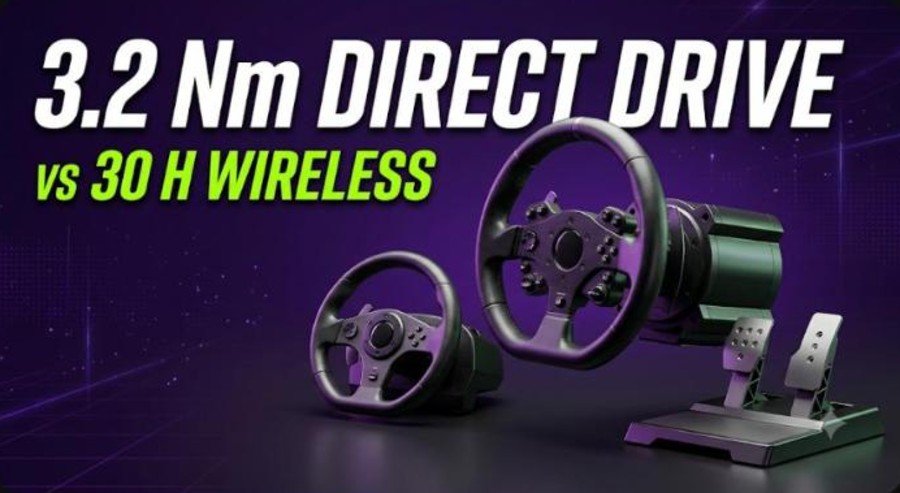
Turtle Beach now sells two very different wheels for Xbox and PC players. The Turtle Beach Racer is a $179.99 wireless wheel with no pedals and no force feedback, built for casual play on a couch or desk. The VelocityOne Race KD3 is a direct drive wheelbase with pedals, a 3.2 Nm motor and a street price near $299.99 after a $449.99 launch price. Both launched on 9 September 2025 and both are Xbox licensed, so the real question is how much racing wheel you actually want.
This review puts them side by side. We cover design and build, what is in the box, how each one drives, pedals and paddles, software, setup, and where they sit against rivals such as the MOZA KS Pro and CS Pro wheels. If you are still choosing a platform, our ROG Xbox Ally X review shows how far Xbox-branded PC gaming has come, and our handheld gaming PC guide covers portable options.
How we built this review
This article combines official specifications from Turtle Beach for the VelocityOne Race KD3 and the Racer, independent coverage from GamesRadar, TechRadar, Windows Central, Tom’s Guide, COGconnected and others, and two YouTube reviews: Sim Tourist on the KD3 and GAMINGTREND on the Racer. Every measurement and opinion below is credited to its source.
Turtle Beach Racer vs VelocityOne Race KD3: Specs and Quick Verdict
⚙️ Quick Specifications
Full specifications
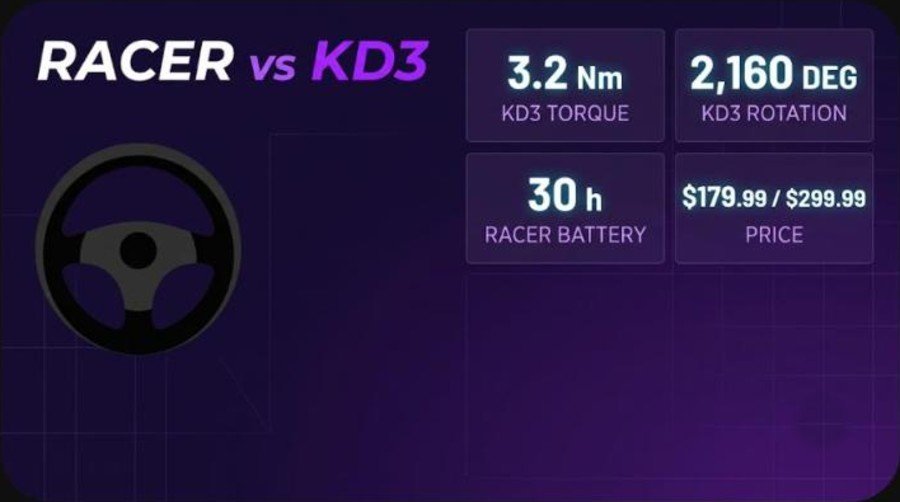
| Spec | Turtle Beach Racer | VelocityOne Race KD3 |
|---|---|---|
| Type | Wireless wheel, no pedals | Direct drive wheel and pedals |
| Force feedback | None, no rumble | K:Drive direct drive, 3.2 Nm peak |
| Rotation | 360° (180° selectable) | Up to 2,160° |
| Wheel diameter | 10.62 in (Tom’s Guide) | About 30 cm |
| Throttle and brake | Pressure-sensitive analog paddles | Aluminum pedals, Hall effect sensors, adjustable spring tension |
| Shifters | Remap F1 and F2 buttons | Two magnetic paddle shifters |
| Display | None | Full-colour Race Management Display |
| Connectivity | 2.4 GHz dongle, wired USB-C, Bluetooth (Android) | Wired USB-C to USB-A, 4 USB-C expansion ports |
| Battery | Up to 30 h (1,500 mAh per Tom’s Guide) | Mains powered |
| Audio | 3.5 mm jack with volume and chat mix | None |
| Mounting | Two lap rests or built-in table clamps | Table clamp, rig mount inserts |
| Platforms | Xbox Series X|S, Xbox One, Windows, Android 8.0+ | Xbox Series X|S, Xbox One, Windows 10/11 |
| App | Control Center 2 | VelocityOne Tuner (Xbox, PC, iOS, Android) |
| Launch price | $179.99 / £139.99 | $449.99 / £329.99 |
The Good and the Bad
👍 The Good
- ✔ The Racer is wireless with about 30 hours of battery, and TechRadar found that figure accurate.
- ✔ The Racer lap rests let you play on a couch, and reviewers found them stable.
- ✔ The KD3 is a real direct drive wheel with pedals for far less than most rivals.
- ✔ The KD3 wheel rim has a soft rubber grip that Sim Tourist rated above leather.
- ✔ Both are Xbox licensed and set up in minutes on Xbox Series X|S.
👎 The Bad
- ✘ The Racer has no pedals and no force feedback, so it cannot convey grip or road texture.
- ✘ The KD3 force feedback is inconsistent between games, and GamesRadar found console compatibility problems.
- ✘ The KD3 buttons feel cheap, and the pedals are the weakest part of the bundle.
- ✘ The KD3 has only two pedals and no clutch, and the ecosystem is small.
- ✘ Neither works on PlayStation.
Buy the Racer if you want a cheap, wireless wheel for relaxed Xbox racing. Buy the KD3 if you want force feedback and pedals on a budget and can live with firmware rough edges. Serious sim racers will outgrow both.
Racer vs KD3: Which One Is Right for You?
These two products do not really compete. The Racer replaces a controller with a wheel. It has no motor, so you steer against a centering spring, and throttle and brake live on the paddles. The KD3 is a proper wheel and pedal set that pushes back, which makes it the closer relative of a sim rig. TechRadar describes the Racer as a strong budget choice for newcomers and casual or younger players and a poor fit for sim racers, while it calls the KD3 its favorite budget direct drive bundle.
| Turtle Beach Racer | VelocityOne Race KD3 | |
|---|---|---|
| Best for | Casual racing on a couch or desk | Budget direct drive on Xbox and PC |
| Force feedback | No | Yes, 3.2 Nm |
| Pedals | No, paddles only | Yes, two-pedal set |
| Wireless | Yes, 2.4 GHz and Android Bluetooth | No |
| Sim racing use | Not intended | Entry level |
| Price now | $179.99 | About $299.99 (launch $449.99) |
What Is in the Box
VelocityOne Race KD3
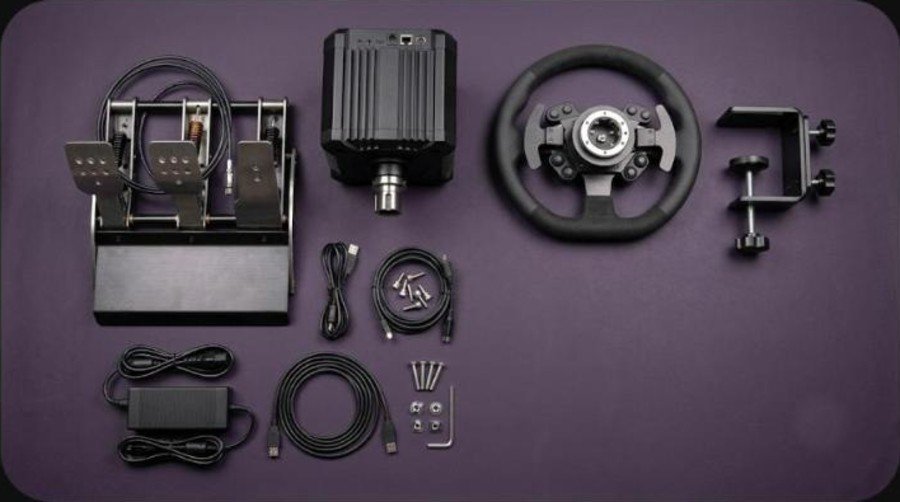
Turtle Beach lists the wheelbase, the wheel module, the pedal unit, four pedal stability pads, a USB-C to USB-C pedal cable, a USB-C to USB-A connection cable (both 2.5 m), a power supply, a table clamp, eight M6 screws for a sim frame and a Quick Race insert. Windows Central also noted that the set includes everything needed to start and that mounting takes only a few screws.
Turtle Beach Racer
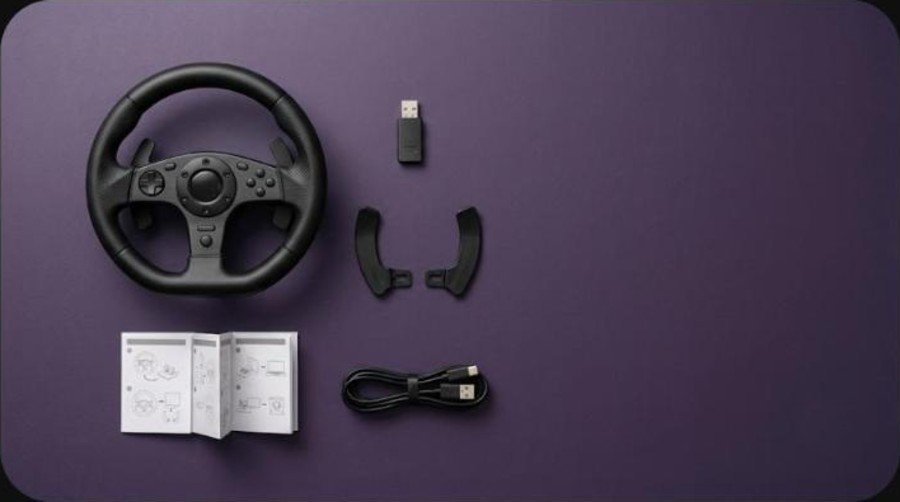
The Racer box holds the wheel, a USB wireless transmitter, two lap rests, a 10 ft USB-C to USB-A cable and a quick start guide. The 2.4 GHz dongle stores inside the base of the wheel. The GAMINGTREND reviewer jokes that it may be the fastest unboxing ever, and warns that you should grab the dongle before you fit the lap rests.
Design and Build Quality
KD3 wheelbase and wheel
The KD3 base is cylindrical, about 15 cm long and 13 cm wide according to GamesRadar, with yellow accents on the housing. Sim Tourist calls it the first cylindrical wheelbase he knows of and likes the RGB ring around the quick release and the 2 x 3 cm colour display built into it. The back has four USB-C expansion ports and a mechanism to angle the base on the fly. The wheel is about 30 cm across, with eight illuminated buttons, a D-pad and two encoders, plus magnetic shifters.
Reviewers agree the rim feels better than it should at this price. Sim Tourist found the soft rubber nicer to touch than the leather rim on the original VelocityOne Race, and Windows Central likewise prefers it for gloveless driving. GamesRadar was less kind, calling the included wheel disappointing, with a visible seam, a plastic centre and plastic buttons. Sim Tourist flagged a small amount of play where the wheel meets the quick release. TechRadar says the bundled wheel is the cheapest feeling part of the package and calls the FR-X formula wheel borderline mandatory.
Racer wheel
The Racer is mostly plastic with soft-touch grips. COGconnected says it looks and feels good, with a smooth texture, though the body is fairly plasticky and the reviewer wanted the grip to run across the top. TechRadar found the build good for the price and the rubber grips non-slip. A flat-bottom shape gives extra leg room, and a bright centre stripe helps you keep your bearings.
Pedals, Paddles and Controls
KD3 pedals
Turtle Beach calls the pedals adjustable aluminum with Hall effect sensors. Reviewers describe the build differently: Sim Tourist says they are almost entirely plastic apart from the pedal faces, and GamesRadar says the pedals sit on one large plastic tray with metal faceplates and feel cramped. Both agree they are sturdy enough. You can tune spring tension and throw, which Sim Tourist calls rare in starter pedals, but there is no load cell option. Rectify Gaming rates them the weakest part of the bundle, and the set has no clutch and no way to add a third pedal to this version.
Rubber pads keep the base from sliding. TechRadar found the pedals stayed put on different floors and had good spacing, though brake resistance is lighter than a stiff GT-style pedal.
Racer paddles and buttons
The Racer has no pedals, so two pressure-sensitive analog paddles on the back act as brake and throttle. Tom’s Guide says they register quickly, while COGconnected wants larger paddles because holding one through a deep turn can feel awkward. You also get a D-pad, face buttons, two remappable quick-action buttons and a 3.5 mm headset jack with volume and chat mix. There is no right thumbstick, so some games lose camera control. If you map gears to the paddles, GAMINGTREND suggests buying a cheap pair of pedals instead.
Force Feedback and Driving Feel
Video: Sim Tourist tests the KD3 in ACC, BeamNG and Taxi Simulator and lists what Turtle Beach still needs to fix. Opinions in the video belong to the creator, so treat it as another point of view.
KD3: strong detail, uneven results
The KD3 motor is 3.2 Nm, roughly half the original VelocityOne Race, according to GamesRadar. TechRadar says that is lower than rivals on paper but strong enough to convey weight, rear slip, road rumble and brake lockups. The front end felt slightly dull in light open-wheel cars such as F1 25 and Automobilista 2, and better in road and GT cars. Sim Tourist saw a lot more detail than on the first VelocityOne Race in ACC and a snappy return to centre, but missed lateral force in fast corners.
Results change by game. Sim Tourist found the force feedback very light in Taxi Simulator and patchy in BeamNG, with no effect on crashes, but he argues the hardware is not the limit because ACC felt good. GamesRadar was harsher on Xbox, saying the wheel gave almost no track surface feedback on straights and that Forza Horizon 5 and Forza Motorsport pulled the wheel to one side because of an inner deadzone. Windows Central found the feedback strong but a little muted at high settings and says firmware has improved it.
Racer: a spring and nothing else
The Racer cannot give force feedback or vibration. Tom’s Guide says it cannot convey tire grip, weight transfer or road texture, and calls that disappointing but not a dealbreaker at the price. TechRadar adds that the wheel snaps back to centre quickly and that you feel a bump as it passes neutral. Even so, COGconnected says Forza Motorsport worked very well, and Tom’s Guide reports good control in drifting and wheel-to-wheel racing in F1 25 and Forza Horizon 5.
Setup, Mounting and Software
Mounting
The Racer has built-in table clamps and two metal lap rests. GAMINGTREND shows that no tools are needed: you loosen the clamps, slide it on a table and tighten, or swap to the lap rests for a couch. COGconnected found the lap rests stable but too short for adult thighs, while Tom’s Guide preferred lap mode and found it comfortable for long sessions.
The KD3 base has a built-in table clamp and threaded inserts for a sim frame. Rectify Gaming reports that the clamp is pressure fit rather than bolted and shifted under use, while GamesRadar says the wheelbase needs the clamp to stop it rolling and used a Playseat. If you plan to race seriously, budget for a stand or rig, much like the desks in our gaming desk guide or the FlexiSpot L-shaped desk review.
Software and firmware
The KD3 uses the VelocityOne Tuner app on Xbox, PC, iOS and Android for firmware, profiles, lighting and paddle mapping. Windows Central says a firmware update is essential, the wheel was not detected on PC out of the box, and the update took about 15 minutes. Sim Tourist found only four driving settings and a wheelbase menu bug where you cannot back out of a submenu without restarting. The Racer uses Control Center 2, which TechRadar describes as free and detailed, with paddle response modes, deadzone, button remapping and rotation, though Complete Xbox found the app fiddly.
Game compatibility
Compatibility is the Racer’s weak spot. Tom’s Guide recommends checking Turtle Beach’s list before buying, and COGconnected found that F1 2024 did not respond correctly while the wheel’s controller mode helped in other titles. On the KD3, GamesRadar reported console problems: F1 24 ignored a button press, Wreckfest registered buttons but not steering, and Farming Simulator 25 only partly worked. PC support looked better, with Sim Tourist listing ACC, BeamNG and Taxi Simulator as supported.
Video: GAMINGTREND unboxes the Racer, shows the lap rests and table clamps, and tests it wirelessly in SnowRunner. Opinions in the video belong to the creator, so treat it as another point of view.
Price, Alternatives and How They Compare
Racer alternatives
At $179.99 the Racer sits between budget pad-and-pedal wheels and mid-range force feedback sets. Tom’s Guide compares it with the Hori Racing Wheel Apex ($119.99, 270° rotation, PS5, PS4 and PC, pedals included but a cheap build) and the Logitech G920 ($299.99, 900° rotation, strong force feedback). It also suggests the Thrustmaster T128, at about $199, for buyers who want force feedback. If you pair a wheel with a headset, the Racer’s 3.5 mm jack works with models such as the HyperX Cloud III S Wireless, the SteelSeries Arctis Nova 5X or the Razer BlackShark V3 Pro.
KD3 alternatives
Windows Central compares the KD3 with the Logitech G923, which delivers 2.3 Nm and feels cheaper, and the MOZA R3 bundle, which has 3.9 Nm but a weaker Xbox software experience and was about $299 on Amazon at the time. TechRadar lists the Thrustmaster T598 at $499.99 with 5 Nm and PlayStation support, and the Nacon Revosim at $799.99 with 9 Nm for PC only. GamesRadar says the Logitech RS50 leads the field because its compatibility mode emulates the widely supported Logitech G Pro wheel, which makes the KD3’s game support look worse.
| Wheel | Price | Torque | Platforms |
|---|---|---|---|
| Turtle Beach Racer | $179.99 | None | Xbox, PC, Android |
| VelocityOne Race KD3 | $449.99 launch, about $299.99 now | 3.2 Nm | Xbox, PC |
| MOZA R3 bundle | About $299 to $399 | 3.9 Nm | Xbox, PC |
| Thrustmaster T598 | $499.99 | 5 Nm | PC, PS4, PS5 |
| Logitech G923 | Varies | 2.3 Nm | Xbox, PC, PlayStation |
Price matters more than usual here. The KD3 launched at $449.99 and Windows Central still lists that MSRP, but Turtle Beach and several retailers now sell it for $299.99. At that price it is much easier to recommend. A wheel also needs a comfortable place to sit: our budget gaming chair guide, the Secretlab Titan Evo review and the Titan Evo vs Embody comparison cover seats, and the OLED gaming monitor comparison helps with the screen.
Verdict: Who Should Buy the Racer or the KD3?
Reviewers rate the pair fairly. Gstyle Magazine gave the KD3 9/10 and Rectify Gaming gave it 8.5/10, while COGconnected scored the Racer 81. GamesRadar’s verdict is that the KD3 should be a compelling mid-range direct drive wheel but is held back by console compatibility and middling force feedback. Windows Central calls it a perfect mid-range entry point for Xbox racing fans. Our view follows: both are good value in their lanes, and neither is a finished sim product.
| Buy it if | Skip it if |
|---|---|
| You want a simple wireless wheel for casual Xbox or PC racing (Racer). | You want force feedback or pedals and cannot add your own (Racer). |
| You want real direct drive feedback and pedals for about $299.99 (KD3). | You want a big upgrade ecosystem or race only on PC, where MOZA is stronger (KD3). |
| You play mostly games on the compatibility list and update firmware (both). | You play on PlayStation (neither works). |
| You value an Xbox-licensed, easy first wheel (both). | You race competitively and want more than 3.2 Nm (KD3). |
Where to buy
Prices and stock move often, so check the current listing before you order.
Check the KD3 on AmazonCheck the Racer on Amazon
As an Amazon Associate, GearZon earns from qualifying purchases.
Frequently Asked Questions (FAQ)
What is the difference between the Turtle Beach Racer and the VelocityOne Race KD3?
The Racer is a $179.99 wireless wheel with no pedals and no force feedback. The KD3 is a direct drive wheelbase with a 3.2 Nm motor, a wheel and a two-pedal set, launched at $449.99 and now sold near $299.99.
Does the Turtle Beach Racer have force feedback?
No. Tom’s Guide and TechRadar both confirm it has no force feedback or rumble, so you steer against a centering spring.
Does the Turtle Beach Racer need pedals?
No. Throttle and brake are on two pressure-sensitive analog paddles. You can map gears to buttons, and some reviewers suggest buying separate pedals if you want paddle shifting.
How long does the Racer battery last?
Turtle Beach rates it at up to 30 hours wireless with a range of up to 30 feet. TechRadar found the claim accurate, and you can play while charging over USB-C.
Is the VelocityOne Race KD3 compatible with PlayStation?
No. The KD3 supports Xbox Series X|S, Xbox One and Windows 10/11 only, and the Racer also supports Xbox and Windows, plus Android over Bluetooth.
How strong is the KD3 force feedback?
The KD3 peaks at 3.2 Nm, which is lower than the MOZA R3 at 3.9 Nm and the Thrustmaster T598 at 5 Nm but higher than the Logitech G923 at 2.3 Nm. Reviewers found strong detail in some games and light or inconsistent feedback in others.
Which Turtle Beach wheel should I buy?
Choose the Racer for casual, cable-free racing on Xbox or PC. Choose the KD3 if you want force feedback and pedals and can accept a small ecosystem and some firmware issues.

